MITCHELL — The industrial park gets the press releases. Main Street gets the empty windows.
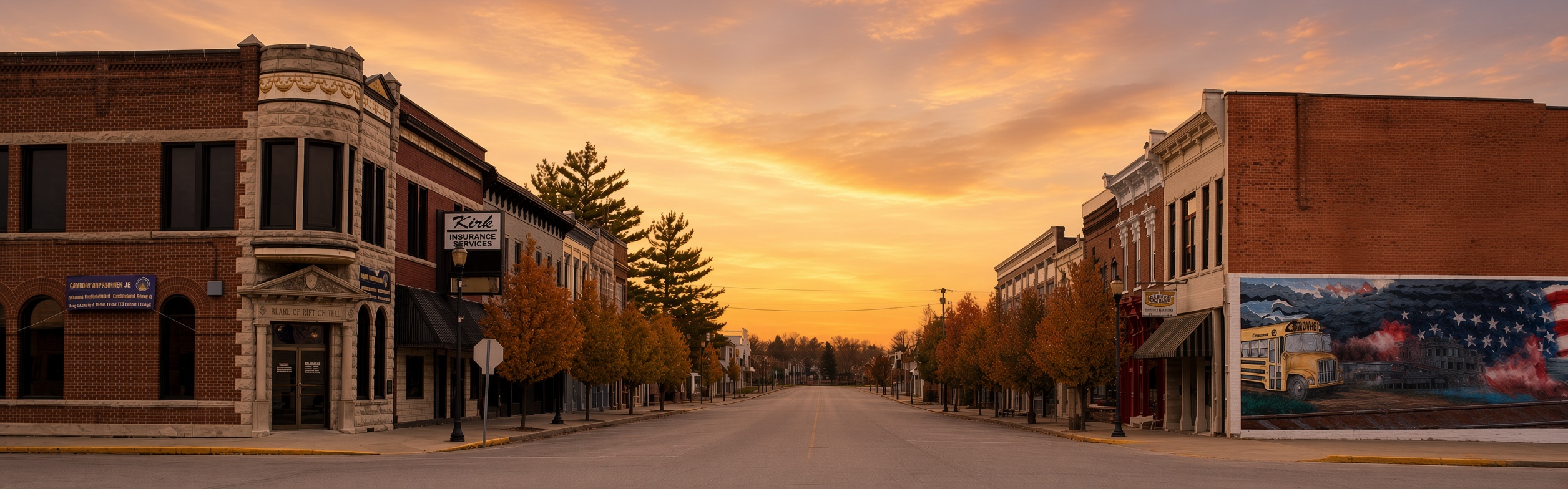
Walk the commercial core of Mitchell and the story is not collapse so much as a long, uneven holding pattern. Some buildings still do what they were built to do. Others have been painted, boarded, fenced, or left to wait for a buyer who never quite arrives. The question hanging over the blocks is simple and unsentimental: can this downtown still hold a business, or is it becoming a corridor of memory with a festival once a year?
What Is Still Open
Mitchell is not a ghost town. Ace Hardware and Ben Franklin still sit on Main Street as one of the last full-service downtown fixtures. A pharmacy remains. Restaurants and small service shops occupy enough storefronts that the street does not feel abandoned at noon. Main Street Raceway still runs slot cars in the middle of the old commercial row. Hoosier Uplands keeps an institutional footprint. During Persimmon Festival week the sidewalks fill and the town looks, briefly, like the place people remember.
That is the occupied half of the picture. It is real. It is also thinner than it used to be.
What Is Coming Down
At 628 West Main Street, the former Mitchell Bank building has sat vacant for about fifteen years. It was a bank, then a dry cleaner, then police headquarters. The city showed it to Indiana Landmarks and Radius Indiana. A structural study followed. From the street it did not look catastrophic. Inside, officials said, it was. In 2026 Mitchell received a $500,000 blight-clearance grant to demolish it. The plan is not another storefront. The plan is green space, expanding Friendship Park next door.
Across the street another unsafe building—long used as an antique shop—sits behind safety fencing. The pair of structures tell the same story from two lots: when a downtown building sits empty long enough, the argument stops being about tenancy and starts being about liability.
Not everyone wanted demolition. When the city asked for public comment on the grant, residents split the usual way. Save the history. Tear it down and do something useful. Force the owner across the street to deal with that eyesore too. One would-be buyer said they had looked at another downtown building and could not get the fire marshal to meet them. That is the other half of Main Street’s problem. It is not only vacancy. It is the gap between wanting a building and being able to occupy one legally.
The Market That Is Left
Storefronts still change hands, sometimes cheaply. Mixed-use buildings on or near Main have listed in the mid-five-figures. A larger Main Street commercial building sold in 2025. The prices suggest opportunity until you add the renovation, the code work, the parking, and the question of who the customer is on a Tuesday in February.
Spring Mill State Park sits just outside town and still sends some visitors down the road. The festival still works. Neither is a substitute for daily traffic. Bedford’s commercial energy has concentrated on John Williams Boulevard and 37. Mitchell’s downtown is competing with that corridor, with online retail, and with the simple fact that many of the services that once required a Main Street address no longer do.
Who Still Believes
The believers are not imaginary. The Redevelopment Commission keeps Mitchell downtown building activity on the agenda. The city pursued the blight grant because leaving a condemned bank on Main Street was worse than an empty lot. Property owners still list buildings. A few operators still open the door every morning and make a living without a highway frontage.
Belief, though, is not the same as a plan that fills windows. Demolishing a fifteen-year vacancy and calling the result a park is a kind of honesty. It admits the building will not come back as a bank, a cleaner, or a police station. Whether the next person who wants a shop on Main Street can get through inspections, financing, and a thin customer base is the harder test.
Mitchell’s industrial park was built to attract companies that need docks and ceiling height. Main Street was built for a different economy. The park may yet land a tenant in the shell building. The storefronts will be won or lost one building at a time, by people willing to bet that a small southern Indiana downtown can still support more than memory, a festival, and a hardware store that refused to leave.
Thoughts · 1