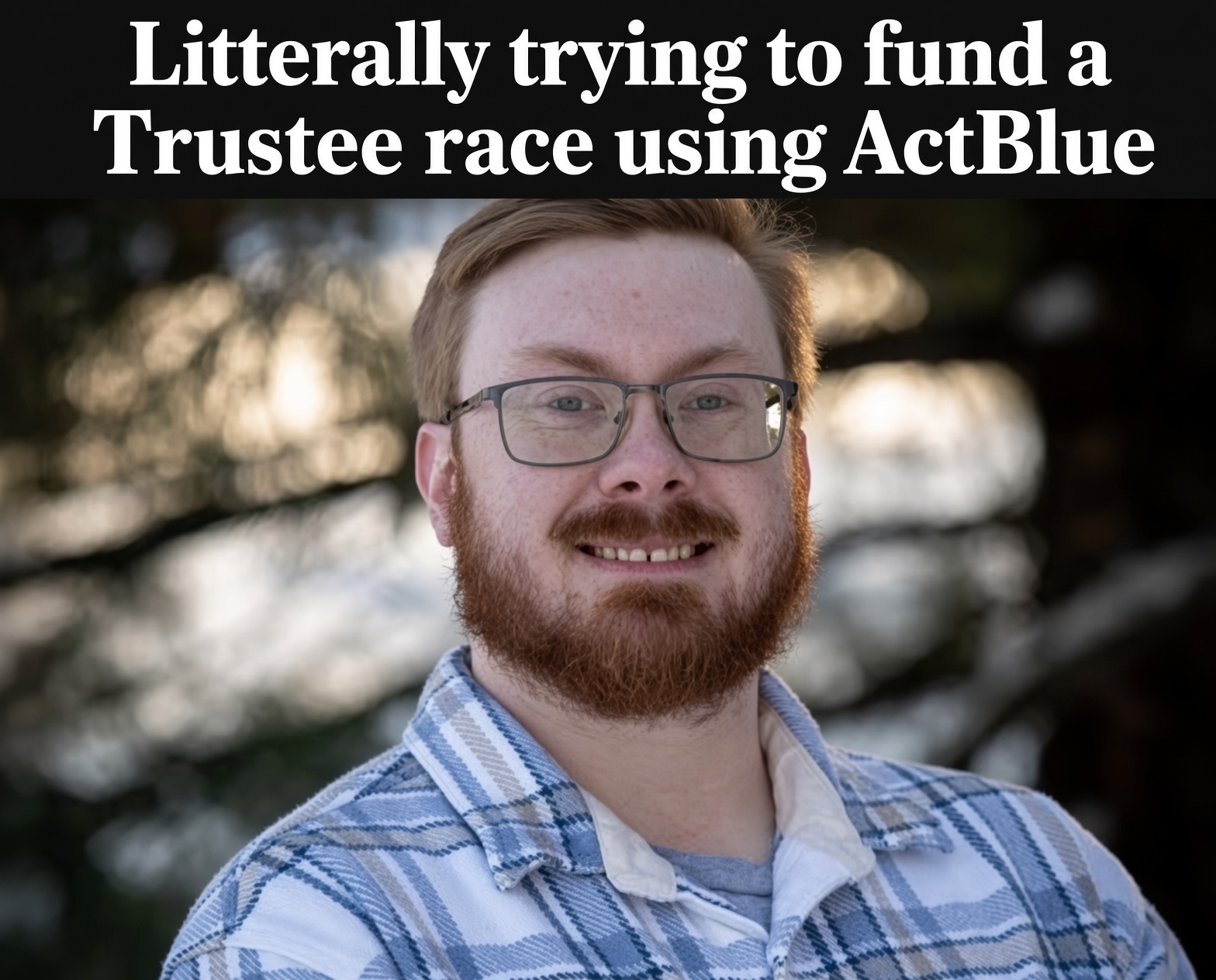
Rowdy Abbott and the Case Against the Township Model
 Bob Taylor
Contributor
Bob Taylor
Contributor
Washington Township in Daviess County does not need a foreign-policy desk. It needs someone who can sit at 1100 State Street, take a poor-relief application in person, keep the cemetery mowed, and not treat a four-year trustee job like a starter kit for national politics.
Rowdy Abbott is on the November ballot as the Democrat for Washington Township trustee. The Republican is Michelle R. Guy, the incumbent. She has held the office for years. Public payroll records show her as trustee back to at least 2017. In 2025 the job paid about $46,000. That is not a glamorous salary. It is a working local office: township assistance, records, weeds, fences, parks if you have them, fire protection if the township still runs it, and a budget the three-member board has to pass.
Abbott’s public pitch, as local radio put it when he filed, was “greater awareness and accountability.” He said a lot of people do not know what a trustee does. That part is true. It is also the problem. The office is obscure enough that a candidate with no published biography, no Ballotpedia survey, and no listed endorsements can walk in and treat it like a microphone.
What the job is, and what it is not
Indiana’s township trustee is not a congressman. The State Board of Accounts list is almost aggressively boring: keep the books, pay the bills, administer township assistance, maintain cemeteries, knock down noxious weeds, look after township property. Poor relief is the heart of it. A family comes in because the furnace died or the rent check bounced. The trustee is supposed to know the statute, the income rules, and the difference between help and a handout.
That work does not require a take on the latest national culture fight. It requires judgment, discretion, and the ability to say no without turning the office into a seminar. When a candidate starts loading a township race with the same themes that belong on cable news — the ones that divide a country of 330 million instead of a township of a few thousand — the office has already been misunderstood.
Daviess County is not a think tank. Washington is a county seat with factories, farms, hospitals, and people who still expect local government to stay in its lane. A trustee who spends campaign energy on national progressive framing is advertising the wrong skill set. The poor-relief line does not care about your views on the Senate. It cares whether the application was taken in the office, as the current trustee page still requires, and whether the money was spent by the book.
Why the township model invites this
Indiana still has about a thousand townships. Many of them are small, low-turnout, and lightly covered. That is how you get a race in which one side has a multi-year payroll trail and the other side has a Facebook page and a first name that sounds like a radio handle.
Low visibility is not charm. It is a structural defect. When almost nobody can name the trustee, the job becomes a vacant lot for whoever wants a title. Sometimes that person is a competent neighbor who already knows the cemeteries and the assistance rules. Sometimes it is someone using a township letterhead to rehearse a politics that does not belong there.
The state has already admitted the model is tired. Senate Enrolled Act 270, now Public Law 134, tells the Department of Local Government Finance to score townships by the end of 2026. Townships that pile up enough poor-performance points have to merge or, in some city-overlap cases, fold into a municipality. Mergers are supposed to be done by January 1, 2029. The point of the law is not ideology. It is that too many little governments cost money, confuse voters, and do not deliver enough service to justify the extra layer.
Abbott is not the first person to treat a township race as a statement. He is a clean example of why the statement keeps happening. The office is small enough to enter and large enough, on paper, to sound like “government.” That combination is catnip for people who want a platform more than they want a caseload.
Experience is key
Guy’s record is not sacred. Incumbents go stale. Voters can fire them. But an incumbent with nearly a decade in the chair at least knows where the forms are. Abbott’s public file, as of now, is thin: a Democratic primary ballot line, a campaign page, and a promise of awareness. Awareness is not a qualification. Knowing how township assistance works is a qualification. Knowing how a cemetery board interacts with a county health department is a qualification. Knowing that national talking points do not pay a light bill in Washington Township is a qualification.
If the Facebook page is doing what readers say it is doing — dragging national progressive fights into a job that should be poor relief and grass cutting — then the mismatch is the story. Township government was built for the last mile: the neighbor who needed coal, the grave that needed a mower, the fire truck that had to come from somewhere. It was not built to host a proxy war over issues decided in Washington, D.C., or on university quads.
The polite conclusion
Phasing out or shrinking townships is not a slur on every decent trustee in Indiana. Plenty of them do the quiet work and never trend. The argument is that the structure now produces too many offices that are easy to capture and hard to watch. When a candidate can turn a trustee race into a national mood board, the voters are not getting a better safety net. They are getting another layer of politics where they needed a clerk with a calculator.
Rowdy Abbott may be sincere. Sincerity does not turn a township into a parliament. If Daviess County wants accountability, it can start by asking the only question that belongs on that ballot: who can run poor relief, keep the books, and leave the rest of the country’s arguments at the door. If the township system keeps inviting the other kind of candidate, the state already wrote the answer. Merge the ones that cannot justify themselves, and stop pretending every six-mile square needs its own campaign.
Thoughts · 2